Sustainability Is The Word
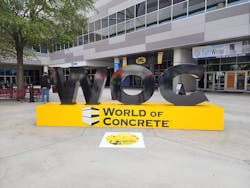
The 49th edition of the World of Concrete kicked off on Tuesday morning at the Las Vegas Convention Center.
The American Concrete Pavement Association (ACPA) opened the show with a press conference on sustainability, which is a theme of the conference.
During the press conference, Eric Ferrebee, a senior director of technical services at ACPA, outlined a white piper titled, “Concrete Pavement’s Role in a Sustainable, Resilient Future.”
The white paper synthesizes research on concrete pavement’s contributions to economic, environmental, and social sustainability.
“Our goal is to take everything we’re working on, bring it to one place, and make it digestible,” said Ferrebee, a P.E.
The ACPA educates decision-makers who are involved in the placement and rehabilitation of roadway and highway pavements. This white paper is being released to help guide the industry to meet ever-increasing levels of sustainability.
The white paper describes concrete pavement’s role in sustainability, including:
· The life span of concrete pavement, which provides the greatest economic value over the long term for taxpayers and end users. Concrete can last 30 years or more before requiring a maintenance cycle.
· Research supporting concrete pavement’s many use-phase environmental and societal benefits, including improved fuel efficiency, high albedo (which improves the earth’s energy balance and urban heat island effect, both of which lead to cooling impacts and CO2 reduction) and CO2 absorption.
· Examination of how the concrete pavement industry and others across the concrete value chain are working together to implement the PCA’s “Roadmap to Carbon Neutrality,” with a goal of achieving net zero carbon emissions by 2050. (Examples include reducing cement’s carbon footprint using blended cements and reducing concrete’s carbon footprint using performance-engineered mixtures.)
· The importance of life-cycle thinking in addressing social sustainability, particularly concrete pavement’s long life (which not only provides a smooth, safe roadway for the traveling public but reduces the hazards associated with work zones throughout the life of the pavement); its ability to withstand, respond to, and recover rapidly after a disruptive event; and good performance with minimal traffic disruption due to maintenance.
“Installing long-life pavements is one very important way of improving sustainability,” said Steve Friess, chairman of the board for ACPA. “Another big contribution to sustainability, and one that I and my company have been personally involved in, is developing performance mixes to reduce cementitious content. As an industry, we’re seeing significant success with with such mixes.”
About the Author
 Gavin Jenkins, Head of Content
Gavin Jenkins, Head of Content
Head of Content
Gavin Jenkins is an award-winning journalist based in Pittsburgh. His work has appeared in The New York Times, The Washington Post, The Atlantic, VICE, Narrative.ly, Prevention, the Pittsburgh Tribune-Review and Beijing Review.
In 2020, two stories he wrote for Pitt Med Magazine earned three Golden Quill Awards from the Press Club of Western Pennsylvania. “Surviving Survival” won Excellence in Corporate, Marketing and Promotional Communications – Written, Medical/Health, while “Oct. 27, 2018: Pittsburgh’s Darkest Day, and the Mass Casualty Response” won Excellence in Written Journalism, Magazines – Medical/Health, as well as the Ray Sprigle Memorial Award: Magazines, a Best in Show award.
After graduating from the University of Pittsburgh at Johnstown in 2003, he covered sports for the Bedford Gazette, in Bedford, Pa., and the Martinsville Bulletin, in Martinsville, Va. In 2006, he returned to Pittsburgh to write for Trib Total Media. Based out of the Kittanning Leader Times, he worked for the Trib for two years, and then he moved to Shenzhen, China, to teach English and freelance. After two years in China, he earned an MFA in nonfiction from the University of Pittsburgh.
When he's not at work, he's usually playing with his border-collie mix, Bob.